From Funchal Airport to Quinta do Lorde Marina: How to Plan Your Catamaran Day
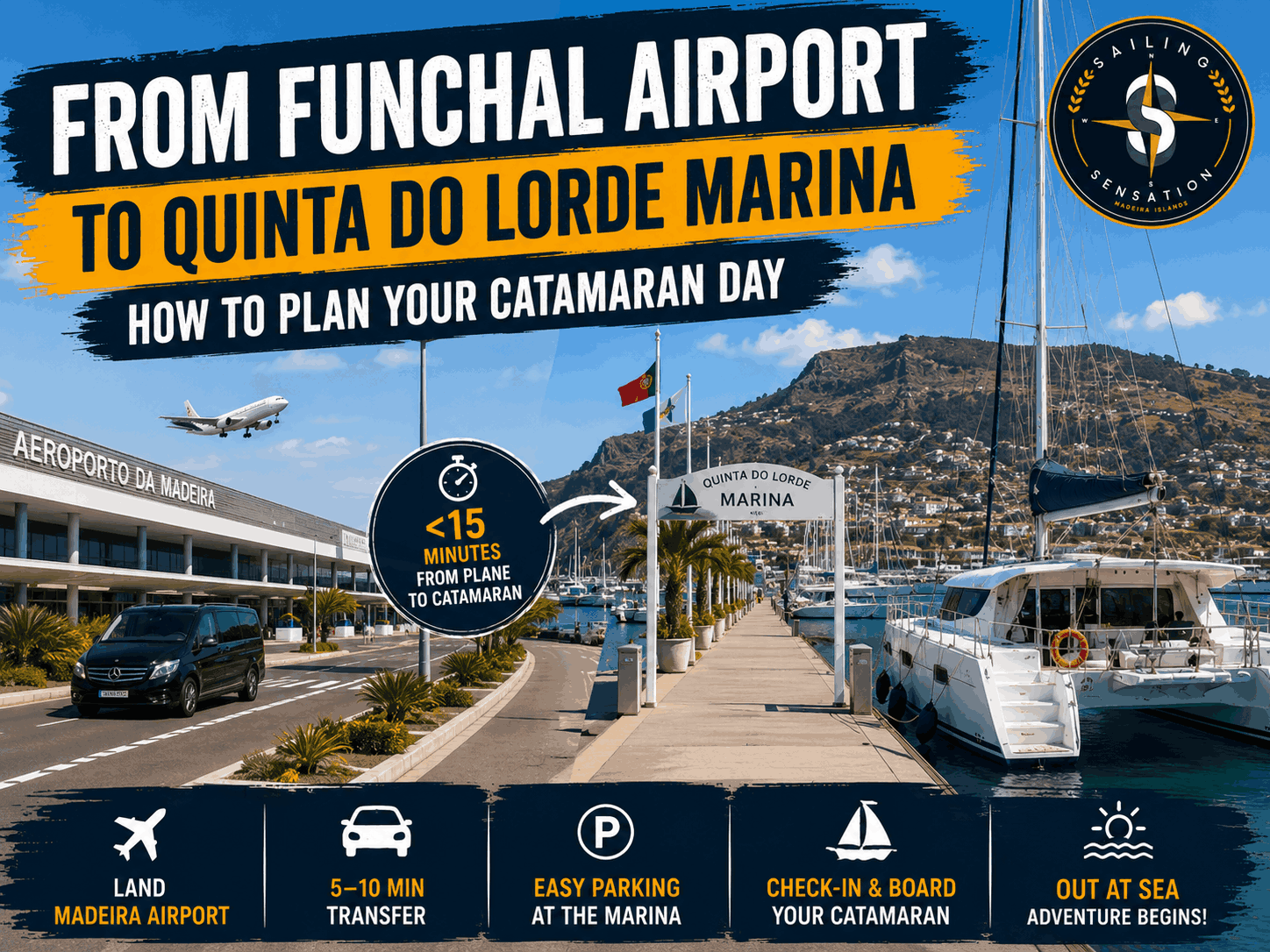
Madeira is one of the few destinations where you can land at the airport and be on a catamaran in th...
Read MoreSelect Language
Service
Slot
Adults
Children (< 12)
This service requires special arrangements and may be subject to permissions and availability. To ensure we meet your specific needs, please get in touch with our team directly. Click below to contact us, and we’ll guide you through the booking process and help tailor the experience to your preferences.
30 January 2026
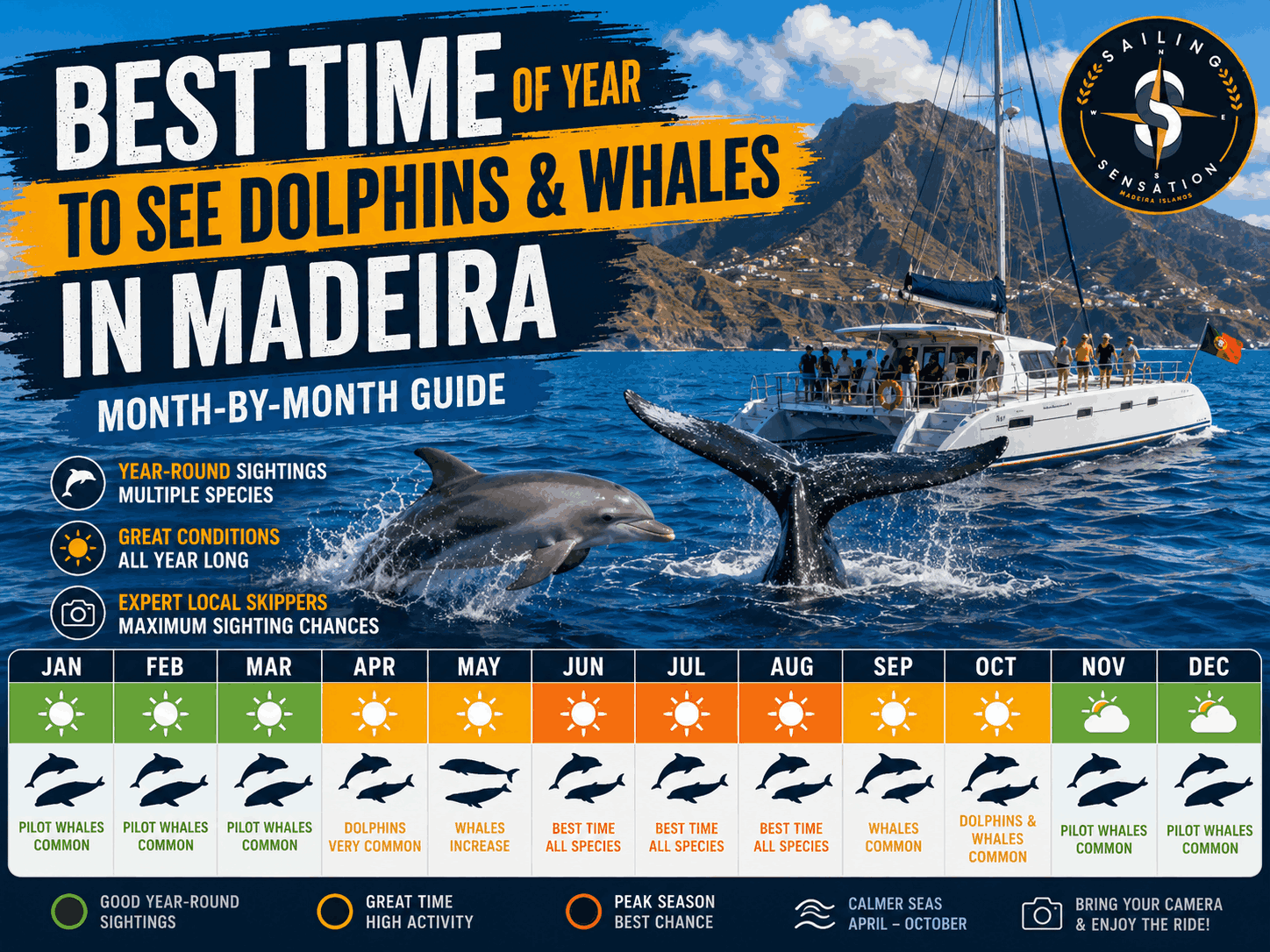
Madeira isn’t just “good” for dolphin and whale watching — it’s one of the strongest hotspots in Europe because deep ocean arrives incredibly close to shore (thousands of meters deep within only a few kilometers), creating a fast route from coastal waters to true pelagic habitat.
That geography helps explain a headline statistic that surprises most guests: around 26–30 cetacean species (dolphins + whales) have been recorded around Madeira, depending on the dataset and how the archipelago area is defined.
And unlike many destinations that rely on short migration windows, Madeira has year-round encounters thanks to resident and regularly occurring species — especially dolphins, pilot whales, and deep divers like sperm whales.
Below is a field-guide style list of 10 dolphins and whales you can realistically encounter around Madeira, plus where to look, when sightings peak, and what to photograph.
Think of sightings in “lanes” rather than a single point on a map. Routes shift daily with wind, swell, prey, and animal movement — but these zones are consistently productive:
Typical corridor: between the south coast and deeper offshore waters (often used by operators leaving from marinas on the south side).
Why it works: deep bathymetry close to shore → fast access to deep-diving whales and wide-ranging dolphin pods.
Calheta and the nearby west/southwest coast are described as an ideal area for marine watching.
Routes that run east along the coast and out into deep water are common from the main marinas (weather dependent).
Desertas Islands: often combined with wildlife trips; known publicly for monk seals, and offshore waters can also deliver cetaceans.
Selvagens Islands: remote and highly protected; conditions and permits matter, but ecologically it’s part of the wider “big ocean” system around Madeira.
Good-to-know (realistic expectations): Madeira has strong sighting rates, but wildlife is never guaranteed. Some operators publish very high “success rate” numbers (e.g., morning vs afternoon), but treat these as operator-reported statistics, not a promise.
Why it matters in Madeira: One of the most reliable year-round dolphins here.
Stats (global): 6–13 ft (1.8–4 m), 300–1,400 lb (136–635 kg), lifespan 40–60 years.
How to spot: chunky body, tall curved dorsal fin, confident surface behavior.
Where around Madeira: coastal and near-offshore pods; frequently along the south coast corridor.

Stats (global): ~6 ft (1.8 m), ~170 lb (77 kg), lifespan ~40 years.
How to spot: striking “hourglass” yellow/cream flank pattern; fast, acrobatic groups.
Madeira notes: Commonly listed among Madeira’s watchable dolphins.

Madeira notes: Often described as a seasonal visitor in Madeira.
Stats (global): 5–7.5 ft (1.5–2.3 m), 220–315 lb (100–143 kg).
How to spot: spots increase with age; lively, surface-active groups.

Stats (global): males up to ~9 ft and ~350 lb; females up to ~8 ft and ~330 lb.
How to spot: bold dark “stripe” line from eye to flank; quick, athletic porpoising.
Madeira notes: Recorded in Madeira watch logs and is a known offshore dolphin here.

Stats (global): lifespan at least ~35 years; adults mature around 8.5–9 ft length.
How to spot: blunt head (no distinct beak), tall dorsal fin, and heavy white scarring on adults (from squid prey + social interaction).
Madeira notes: Appears in Madeira species lists and sightings logs.

Stats (global): up to ~8.5 ft (2.6 m) and ~350 lb (160 kg).
How to spot: sleek “reptilian” head profile, long narrow rostrum, typically more offshore/deep-water behavior.
Madeira notes: Included in Madeira sighting summaries/logs.

Madeira notes: Common year-round and repeatedly highlighted as a resident/regular species.
Stats (global): 12–24 ft (3.7–7.3 m), 2,200–6,600 lb (1,000–3,000 kg), lifespan 35–60 years.
How to spot: rounded “melon” head, thick body, stable family pods.

Madeira notes: A flagship deep diver for the archipelago; present year-round in the region’s deep waters.
Stats (global): routine hunting dives around ~2,000 ft (~600 m) lasting ~45 minutes (records can be far deeper/longer).
How to spot: squared head, low angled blow, long “resting” sequences at surface before deep dives (look for the tail fluke lift).

Madeira notes: Regular in warmer months; in the NE Atlantic (including Madeira) Bryde’s whales have been documented as regularly seen from late spring through autumn (roughly June–October).
Stats (general): up to ~14 m and ~30 tons (varies by population/complex).
How to spot: sleek rorqual body; can be surprisingly “close-to-surface” and steady-moving.

Madeira notes: One of the large baleen whales that can pass through Madeira’s waters during seasonal movements; reported around peak months in regional guides and sightings logs.
Stats (global): 75–85 ft (23–26 m), 40–80 tons; lifespan 80–90 years.
How to spot: tall column-like blow, long back, fast purposeful travel.

A strong Madeira blog post should clearly explain why the diversity is so high:
Deep sea close to land
Madeira’s seabed drops fast — commonly cited as ~3,000 m depth within ~5 km — so tours reach deep habitat quickly.
High recorded diversity
Multiple references converge around mid-20s to ~30 recorded species:
26 registered in Madeira Whale Heritage Area info
27 confirmed by researchers (World Cetacean Alliance page)
~30 recorded in a peer-reviewed distribution modeling paper
Resident + migratory overlap
Some species are present all year (e.g., pilot whales, bottlenose dolphins, sperm whales), while others peak in warmer months (e.g., Bryde’s).
The best encounters happen when animals choose to stay near you. Practical rules:
Slow approaches, no chasing, no cutting across travel paths.
Keep noise low (especially near sperm whales and calves).
Let dolphins bow-ride if they want — don’t pursue.
This is also consistent with Madeira’s broader emphasis on conservation and heritage around whale watching.
Madeira is one of the few destinations where you can land at the airport and be on a catamaran in th...
Read MorePorto Santo is Madeira's quieter, sandier sister island — 9 km of golden beach and a pace of life th...
Read MoreMadeira has one of the strongest cetacean sighting records in Europe — but ask any local skipper "wh...
Read More